
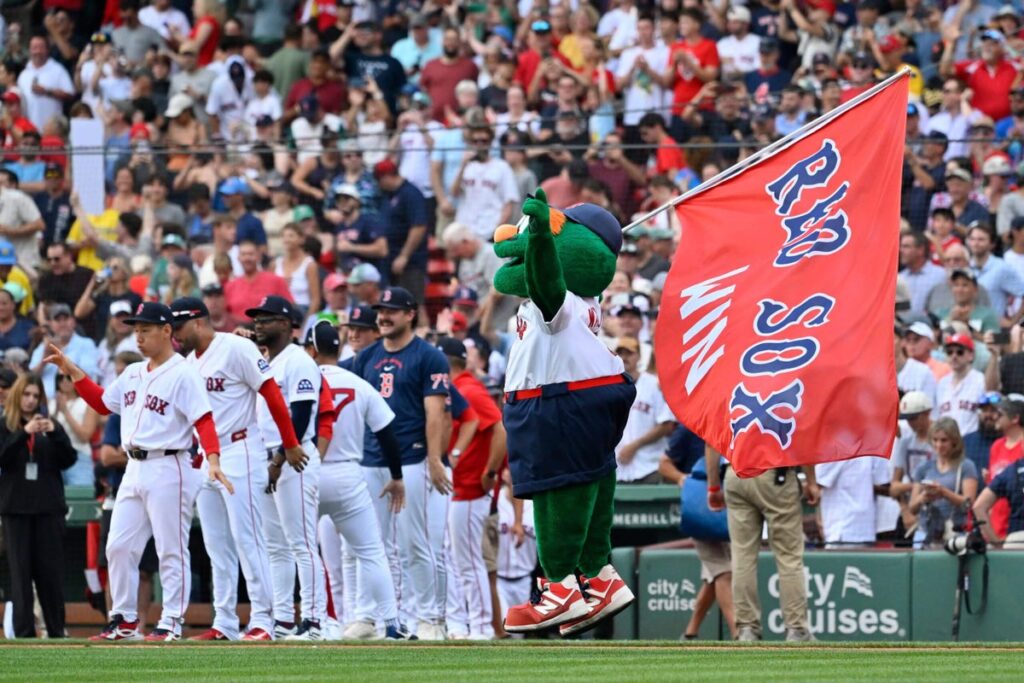
A historic 15-game winning streak for the Boston Red Sox not only pushed them consistently above .500 for the first time this season (52-49) but also squarely into an American League wild-card spot.
The Red Sox looked like a different team during those three weeks and even in the preceding seven games: a four-game sweep of the New York Yankees and a fight-fueled three-game set against the Washington Nationals. Since June 25, the club has gone 20-3 and turned its season around. That level of play, led by stellar pitching, pristine defense and timely offense finally coalescing, has lent credence to the belief this team can be a contender in a topsy-turvy AL despite an atrocious start to the year.
The Red Sox proved, coming out of the break, they could maintain the momentum of their nine-game winning streak by reeling off six more wins. There’s reason to believe they can keep up a high level of play following the streak rather than fall back into the one-win-one-loss mediocrity that defined the first three months.
“What happened within (the streak), the way that the identity of the team changed within it, is most important,” interim manager Chad Tracy said. “What created that (identity)? We’re very aware of the quality of the at-bats, the starts, the bullpen work, and the things that we did. It’s like, if that’s who we are as a team, and we keep doing that, we’re going to win games. So not only did we run off 15 wins, but we found who we are when we’re a good baseball team and what we do.”
Here are five aspects of the club that changed during the winning streak that should convince the front office that the team can contend and they should add ahead of the Aug. 3 trade deadline.
Who are the top prospects in baseball right now?
Keith Law
The small-ball effect
The Red Sox learned to win in more ways than one.
Throughout the streak, the Red Sox began to rely more heavily on small ball. Situational hitting, bunting, sacrifice flies and moving runners over helped loosen the lineup, allowing the power hitters to do their thing without feeling the need to produce in every at-bat. A slew of Triple-A call-ups fighting to stay in the majors contributed to that small-ball mentality.
During the 15-game streak, the Red Sox pressured defenses with 11 stolen bases while recording eight sacrifice bunts and six sacrifice flies. In their previous 85 games, they’d recorded 11 sacrifice bunts and 23 sacrifice flies.
That brand of baseball was on display during the first game of Friday’s doubleheader against the Tampa Bay Rays. Jarren Duran’s two-run single with the bases loaded was followed by back-to-back bunt singles from Carlos Narváez and Tsung-Che Cheng, plating two more runs. There were bigger hits on the day, but the timeliness of those bunts spoke to the confidence with which the Red Sox were playing.
Tsung-Che Cheng lays down an RBI bunt against the Tampa Bay Rays. (Bob DeChiara / Imagn Images)
“There’s a point, I don’t have an exact date for you, but there’s definitely more conversations of, ‘Hey, we gotta bunt more, get guys over. We gotta score a guy; if you have to bunt him, do it. Put the ball in play, grind out at bats,” Caleb Durbin said. “That’s something we’ve been talking about a lot that we struggled to do early on, and that’s been a big difference.”
Earlier in the year, the pressure to score compounded as players searched for the big hit every time. They left 10-plus men on base in game after game. In May, Duran likened their dire offensive situation to a scene from “The Office” in which the boss, Michael Scott, runs around the office screaming, “Nobody panic!” during a fire drill.
“I think of that moment and scream that in the dugout to lighten things up,” Duran said.
“I feel like from my perspective, when we get guys on, it’s like we have to score. I feel like that’s what screws us sometimes. We’re putting all this pressure on ourselves. It’s like, no, we don’t; let’s just go up there and have a good at-bat.”
Since then, the Red Sox have played more as a unit, sacrificing the big hits for situational plays, which in turn has led to wins.
Caleb Durbin’s resurgence
Durbin’s solo homer into the Green Monster seats with two outs in the eighth inning of a tie game on Monday night sent Fenway into a frenzy. Not only had it been a back-and-forth game, one the team surely would have lost earlier in the year, but Durbin’s struggles to start the season mirrored the team’s abysmal start. On May 24, Durbin was hitting .163 with a .479 OPS. Since then, he’s hit .303 with a .893 OPS and turned his season around.
“It means everything,” he said. “I want to be the same guy every single day for these guys in the clubhouse and on the field — on the field that was lacking early on. So, I’m just happy that I’m playing more consistently for these guys.”
Durbin isn’t going to be the main bat, but finding his rhythm at the plate has lengthened the lineup and taken pressure off Willson Contreras and even more so off Wilyer Abreu and Ceddanne Rafaela to be the main sources of production. Abreu’s massive seventh-inning homer on Saturday against the Rays, a stretch in which he hit two home runs in back-to-back games, was another example of that. With Durbin hitting behind Abreu and Contreras on most nights, teams can’t just pitch around those two hitters.
Small ball helps, but the Red Sox hit 23 homers during the streak while scoring 5.9 runs per game, after averaging 4.0 runs per game up to that point.
Adding another bat to the mix would only strengthen the group further.
Defensive prowess
The Red Sox have been a better defensive team all season than in years past, but started on a rough patch, particularly as shortstop Trevor Story struggled to play through a sports hernia before landing on the injured list in May.
Boston recorded just five errors during the streak. On the season, they’ve committed 45 errors — only eight teams have fewer. The Red Sox finished worst or second-worst in the majors in errors in each of the past three seasons.
Cheng and Andruw Monasterio have played standout defense at short while Contreras and Durbin have stabilized the corners.
Cheng’s leaping catch with runners in scoring position in the ninth on Monday saved the game from being tied.
That’s not including contributions from Gold Glove winners Abreu and Rafaela in the outfield, who not only have the range to track down balls but have arms that make teams think twice about advancing. Duran has also made significant strides in left field this season.
Reliably strong pitching
Boston’s pitching has been what’s sustained the team all year, but during the win streak it was even better. The rotation and bullpen posted ERAs of 2.78 and 1.08, respectively. That allowed the offense to do its thing.
During their streak, the Red Sox received some impressive starts. One from Sonny Gray stands out. Coming off the awful travel out of Chicago from July 9 into July 10, in which the Red Sox had two plane issues and arrived just a couple hours before first pitch, Gray shoved.
The veteran was running on empty like much of the team, but still held the Mets to one run over six innings.

Sonny Gray was as consistent as it gets during the streak, winning all three of his starts while pitching six innings and allowing one run in each outing. (Jim McIsaac / Getty Images)
Rookie Jake Bennett began the win streak with an impressive 7 2/3 innings in Los Angeles against the Angels, carrying a perfect game into the fifth before later allowing two runs. He followed that up in his next start against the White Sox with seven scoreless innings.
In the bullpen, Garrett Whitlock made 10 consecutive scoreless appearances, allowing just three hits. Closer Aroldis Chapman collected seven saves in the 15-game stretch. That lockdown pitching across the board kept the Red Sox in games.
The Red Sox will need to rely on their pitching down the stretch and aren’t likely to see Garrett Crochet until late September, as Crochet noted on Monday that he’s trying to return for the postseason. Adding at least one bullpen arm to the mix will help bolster the club, but the Red Sox will also need to figure out how to manage the innings of their three rookie starters.
Winning at home
Earlier in the year, it was almost as if the Red Sox didn’t want to return home to Fenway Park because they were playing so poorly there. Yet their 20-3 stretch run began with four straight wins at home against the Yankees, the most consecutive wins they’d had all season. That homestand finished 5-2.
When they opened at home after the break, they reeled off six straight wins before Wednesday’s loss.
“We had to turn it around at home,” Durbin said. “We knew that, the fans knew that. Everyone knew that. So to be able to do that against divisional opponents and to be able to do it up to this point and hopefully keep doing it’s been huge. It’s a lot more fun to play at home when we’re winning with the fans rocking like they have been.”
Winning at home will be key down the stretch if the Red Sox want to make the postseason, and that might be something they finally figured out during the streak.