
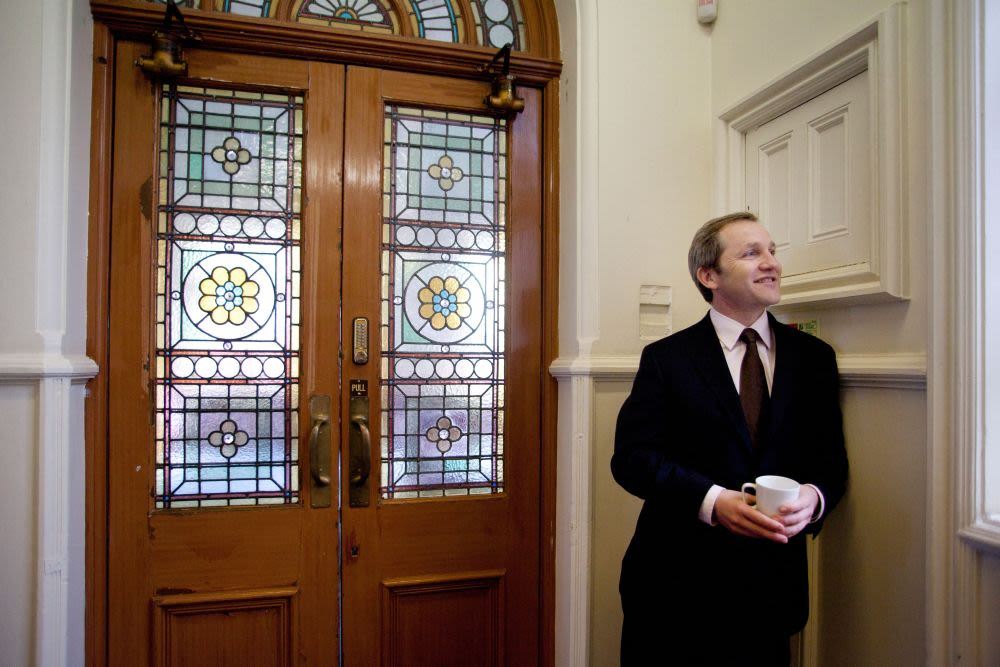
James Purnell was VC at UAL for four years (Alamy)
6 min read1 hr
A Labour government under Andy Burnham could scrap the student loan system and replace it with a graduate tax or stepped repayment system.
James Purnell, who has been picked as Burnham’s chief of staff and was vice chancellor (VC) at the University of the Arts London for four years, has previously been outspoken about reforming the student loan system.
Just two years ago, while Purnell was still VC, UAL commissioned London Economics to model several alternatives to the student loan repayment system, including scrapping the student loan system and replacing it with “a real graduate tax”. Purnell resigned from his role later in 2024 following months-long student protests against the university’s stance on the war in Gaza.
Nick Hillman, former government adviser and now director of Higher Education Policy Institute (HEPI), told PoliticsHome that Purnell was “the most active vice chancellor on the issue of student finance and graduate repayments” while heading up UAL.
The current student loan system was created under the Conservative government, but the issue exploded onto the headlines earlier this year after Chancellor Rachel Reeves insisted that her decision at the November Budget to freeze the threshold at which ‘Plan Two’ graduates start to pay back their loans was “fair and reasonable”.
In a blog for the HEPI think tank in 2024 titled Fixing higher education funding should start with student loans, Purnell argued that “the whole [higher education] system desperately needs reform to ensure the sector’s long-term sustainability”.
As Purnell wrote in his essay, one option is to “scrap the student loan system entirely and replace it with a real graduate tax”.
“A tax tied to income, which no wealthy graduate would be able to pay their way out of, would be genuinely progressive,” Purnell said.
During his campaign for Labour leader in 2015, Burnham pledged to replace tuition fees with a “graduate tax” if he was elected.
Another option mooted by Purnell that, in his words, “would not require such a major overhaul of the system” is the introduction of a stepped repayment system.
Under the changes, higher earners would make repayments for more of the maximum repayment period, thereby subsidising a shortfall in repayments from low and middle-earning graduates. This would effectively mean that higher-earning graduates would pay back more money for longer.
Both of these methods would, Purnell argued at the time, allow for the reintroduction of maintenance grants, a move the Labour government later committed to in 2025.
Hillman told PoliticsHome: “On paper, the stepped repayment model is very progressive: the better you do from your education, the more you repay.”
“But it’s making the student loan system much more like a tax because it’s much less related to how much we borrow. It’s almost based on the idea of how much money can we squeeze out of the best-paid graduates? And it’s breaking that link with their actual borrowings.”
However, Hillman said that the context now has completely changed from when Purnell was doing this work two years ago.
“All those people who were complaining about the current student loan system earlier this year – and of course there was a Treasury Select Committee report on this just last week – they’re all arguing the loan system should become more like a loan and less like a tax.”
Hillman added: “The stepped repayment model is very similar to graduate tax, but the first six months of this year, the argument was all the opposite. It was ‘we hate the high interest rates. We hate the fact that we’re never going to pay off our loans’.”
Purnell also argued in 2024 that “uprating maintenance loans in line with inflation is something that can and should be done immediately”.
Speaking on a panel in the same year, he said that when he speaks to students, their “biggest” worry is “money now, it is not actually what they’re going to repay in the future”.
“The fact that maintenance support hasn’t kept pace with the cost of living is something that has to be fixed and I am amazed that it hasn’t.”
“In the report, there’s an option which looks at bringing in the living wage for students effectively… so there is an option there.”
In 2025, the government confirmed that maintenance loans for students would rise with inflation from the 2026-27 academic year, but MoneySavingExpert.com founder Martin Lewis warned the move was “still not enough”.
Speaking on a Times Higher Education (THE) podcast in 2024, Purnell insisted: “We need to help students while they are studying. The cost of living has become a really damaging barrier for too many students, particularly in London, and the amount of money that students get has not kept up with the cost of living crisis in the way that other areas of public spending have.”

VC of Manchester Metropolitan University Malcolm Press told PoliticsHome that incoming Prime Minister Burnham “is a very very well-known character in all sectors across Greater Manchester” and on campus “frequently”.
Press added that Burnham has “been very interested in student housing and also in student transport”. Press has also worked with Purnell in the past, and told PoliticsHome he believes Burnham’s incoming chief of staff Purnell is “in probably a unique position of having served as both vice chancellor of the university and a government minister”.
“So he’s well placed to understand the sector and well placed to understand the pressures that government ministers are under.”
Purnell’s influence on the higher education system in England stretches back to the last Labour government. In 1999, he co-authored a paper while in the No 10 policy unit for prime minister Tony Blair, recommending an increase in the number attending England’s universities, a recommendation that would later be adopted as government policy with the 50 per cent target.
In 2024, Purnell said that the country had “met the aspiration for a very large number of people to go to university”, but he feared “that that is now at risk partly because some politicians are going off the consequences of those decisions that they were a part of making in the first place when they are faced with the reality of what it means.” He also raised concerns about affordability and the knock-on impact on quality of teaching and class sizes.
Purnell has also previously called for increased investment in the teaching grant, with a more proportionate balance between money coming from the teaching grant and fees.